TL;DR
|
Introduction
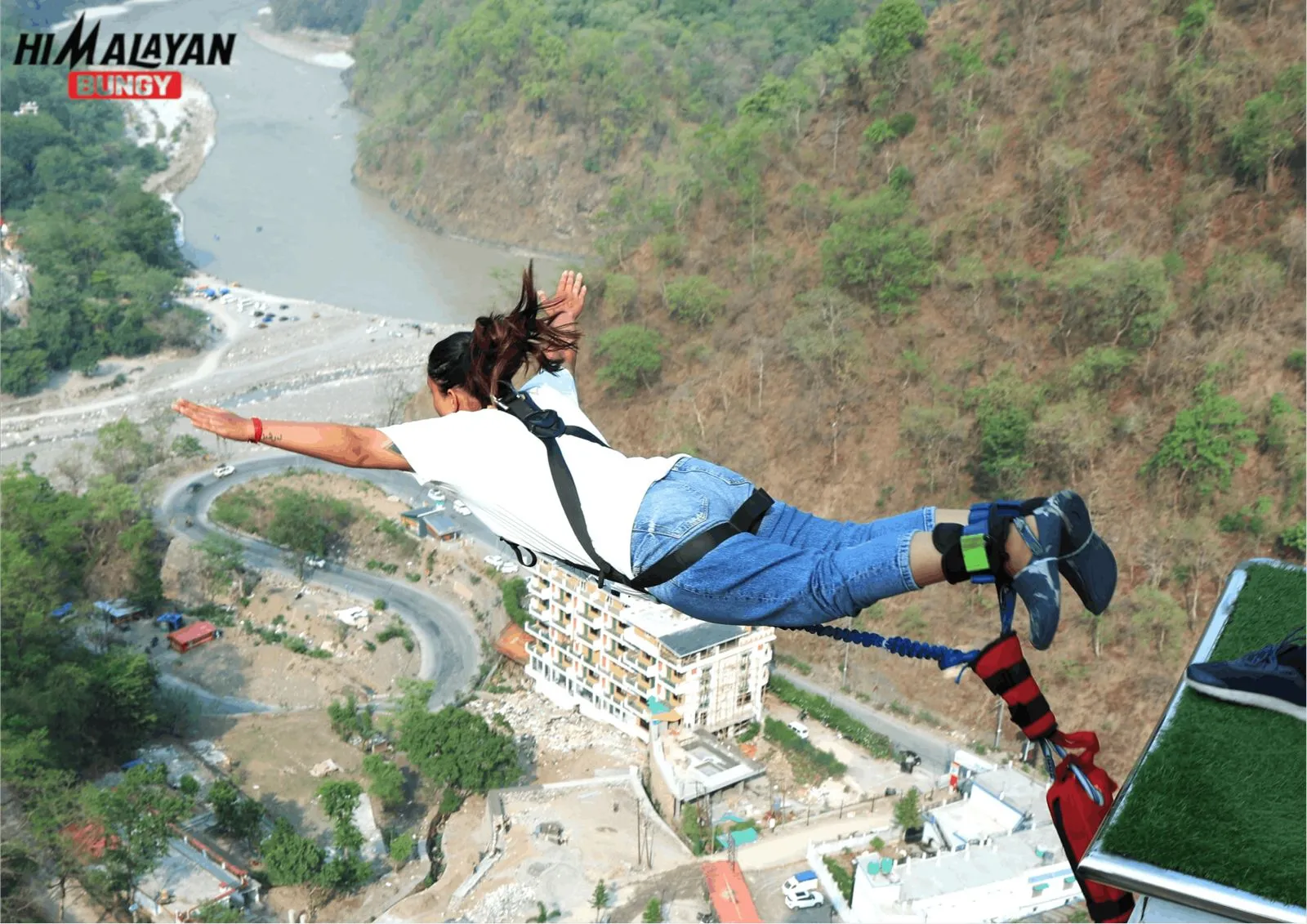
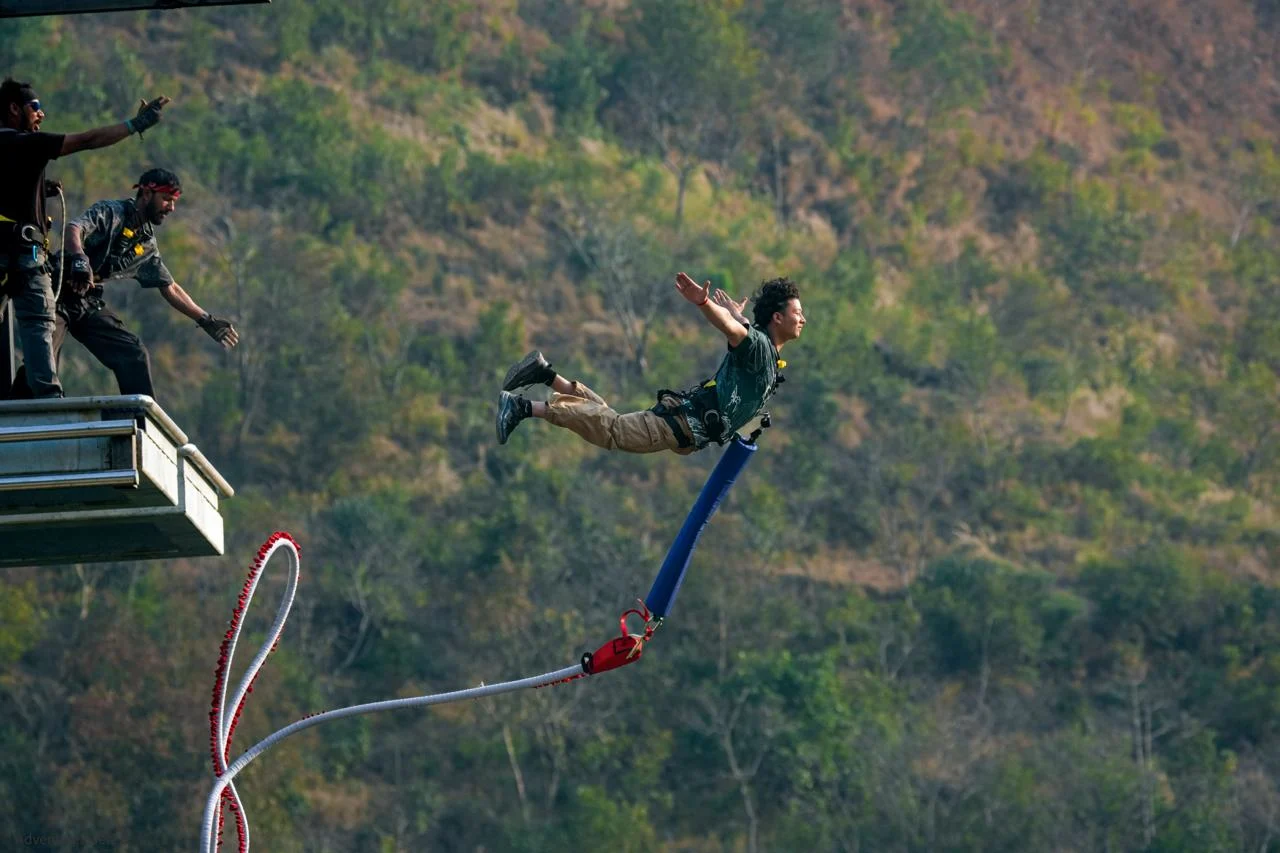
After more than 10 bungee jumps across Rishikesh, I have noticed something interesting. The jump looks like a simple fall, but a lot is happening between the moment you step off and the moment you bounce back up.
During a jump, you first feel gravity taking over as your body moves downward. Then the bungee cord starts stretching, your speed begins to change, and the stored energy pulls you back upward. That experience is one reason bungee jumping in Rishikesh feels so different from simply falling from a height.
That experience made me curious about what actually happens during those few seconds. Why does the cord stretch? Why don't you keep falling? And what makes the rebound controlled?
So, how does bungee jumping work? It comes down to gravity, motion, elasticity, and a professionally designed bungee system working together. In this breakdown, I’ll explain the science behind what happens during a jump, including how the bungee jumping cord helps control your movement.
How Does Bungee Jumping Work?
Bungee jumping works by controlling a fall with an elastic cord and a professionally designed jumping system. Gravity starts the movement, while the cord controls what happens next.
When you step off the platform, gravity pulls you downward. Your speed increases as you continue moving away from the platform.
As the cord stretches, it begins storing energy. This gradually slows your downward movement. The stored energy then helps create the upward movement that follows.
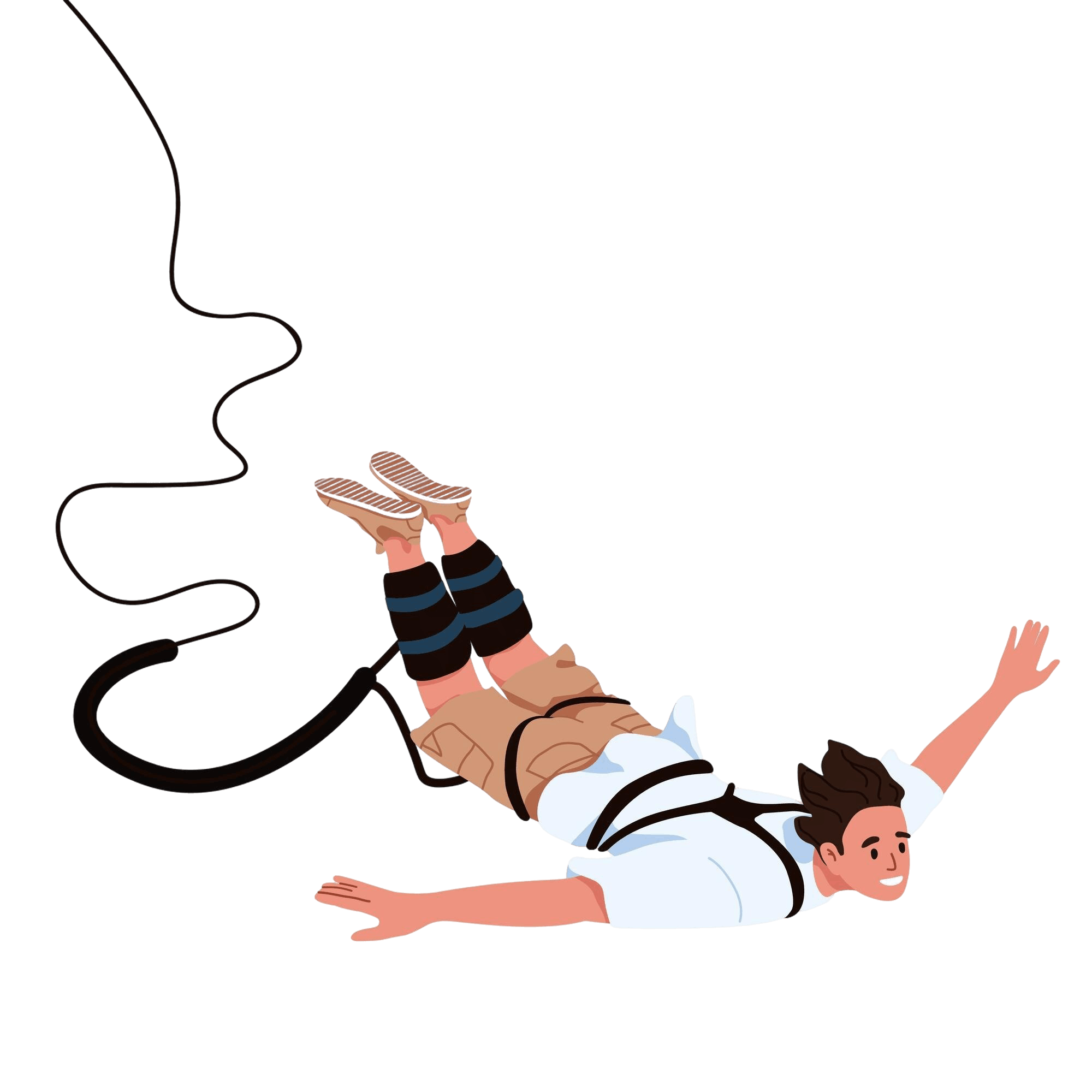
The process has four basic stages:
Stage | What happens |
Jump | You leave the platform and begin moving downward. |
Descent | Gravity accelerates your downward movement. |
Cord stretch | The cord stretches and stores energy. |
Rebound | The stored energy helps pull you upward. |
From my experience with multiple bungee jumps, the interesting part is how smoothly these stages connect. The jump height also affects how much distance you travel during the descent. You can compare different bungee jumping heights in Rishikesh to see how much they vary.
The exact movement depends on your weight, cord characteristics, jump height, and the complete jumping system. This is the basic principle behind how does bungee jumping work.
What Is the Science Behind Bungee Jumping?
The science behind bungee jumping is an energy transfer that happens over a very short period. Several physical principles work together to control the jumper's movement.
After more than 10 bungee jumps, I have seen how quickly these physical changes happen. What looks like one continuous movement is actually a sequence of energy transfers happening within seconds.
Gravitational Potential Energy
Before the jump, your body has gravitational potential energy because you are positioned above the ground.
This energy depends mainly on your mass, gravitational acceleration, and height. In simple terms, a heavier jumper or a higher starting point means more gravitational potential energy.
When you step off the platform, gravity begins converting that stored energy into movement. This is the starting point for understanding how does bungee jumping work.
Gravity and Acceleration
Gravity is the force that pulls your body toward Earth. During the early part of the jump, this force causes your downward speed to increase.
This increase in speed is called acceleration. The longer gravity acts before the cord develops significant tension, the faster your downward movement becomes.
Gravity therefore starts the jump, but it does not control the entire movement.
Kinetic Energy
As your body gains speed, gravitational potential energy is converted into kinetic energy.
Kinetic energy is the energy associated with motion. The faster you move, the more kinetic energy your body has.
This energy becomes important when the cord begins stretching. The cord needs to manage the energy produced by your downward movement.
Elastic Potential Energy
When an elastic material is stretched, it can store energy. This stored energy is called elastic potential energy.
As the bungee jumping cord stretches, some of the energy associated with your downward movement is transferred into the cord.
The cord's elasticity allows it to stretch and then contract. This behaviour is central to bungee jumping physics.
How the Energy Changes During a Jump
The main energy changes can be simplified like this:
Stage | Main energy change | What is happening |
Before the jump | Gravitational potential energy | Your body is elevated above the ground. |
Early descent | Potential → kinetic energy | Gravity causes your downward speed to increase. |
Cord stretching | Kinetic → elastic potential energy | The stretched cord stores energy and slows your descent. |
Lowest point | Energy temporarily stored in the system | Downward velocity reaches zero before the direction changes. |
Rebound | Elastic potential → kinetic energy | The cord contracts and contributes to upward movement. |
Later movement | Mechanical energy decreases | Air resistance and other losses reduce the energy available for each rebound. |
Why the Cord Does Not Stop You Instantly?
A bungee cord is not meant to behave like a rigid cable. Its ability to stretch allows the change in movement to happen over a period of time.
As the cord extends, its tension increases. That tension acts upward against the jumper's downward movement.
The increasing upward force reduces the jumper's downward speed. Eventually, the downward movement reaches its lowest point.
What Happens at Maximum Extension?
At maximum extension, the jumper reaches the lowest point of that particular downward movement.
At this instant, the jumper's downward velocity becomes zero before the direction changes.
The cord is highly stretched, so energy has been stored within the elastic system. Some energy has also already been dissipated through air resistance and other factors.
This distinction matters. Not all the energy from the initial fall is perfectly returned during the rebound.
Why Does the Jumper Move Upward?
After the lowest point, the stretched cord begins contracting.
The energy stored in the cord contributes to upward movement. The jumper therefore changes direction and begins moving back toward the platform.
This is why how does bungee jumping work cannot be explained as simply falling and being stopped. The cord actively participates in changing the direction of movement.
Why Doesn't the Jumper Bounce Forever?
In an ideal system with no energy losses, the movement could continue for much longer.
A real bungee jump is different. Energy is gradually dissipated through several factors, including:
Air resistance as the jumper moves through the air.
Internal energy losses within the elastic cord.
Movement within the complete jumping system.
Other mechanical losses within the system.
Because less energy remains after each cycle, subsequent rebounds become smaller. The movement eventually settles.
Does Air Resistance Affect the Jump?
Yes, but it is not the main mechanism controlling the jump.
Air resistance acts against movement through the air. Its effect depends on factors such as the jumper's speed, body position, and the area facing the airflow.
At higher speeds, air resistance can become more noticeable. It contributes to the overall loss of mechanical energy during the jump.
The Complete Energy Cycle
The easiest way to understand the bungee jumping science is to follow the energy from beginning to end:
Height → gravitational potential energy → kinetic energy → elastic potential energy → upward kinetic energy → energy loss → smaller rebounds
This simplified model explains the main movement. The real system is more complex because jumper mass, starting height, cord properties, air resistance, and the complete setup all influence the result.
Understanding these factors also explains why operators set specific limits for jumpers. Your body weight affects the forces and energy involved, so the Rishikesh bungee jumping weight limit is an important part of the overall jumping system.
How Does a Bungee Jumping Cord Work?
A bungee jumping cord is designed to stretch under load and return toward its original form. Its elastic behaviour makes it fundamentally different from an ordinary rope.
From my experience with multiple bungee jumps, the cord is one of the parts I pay close attention to. Its behaviour feels controlled rather than rigid, which matters when you're dealing with a moving jumper.
What Happens When the Cord Stretches?
When a load is applied, the cord changes length. As it stretches, tension develops within the material.
The relationship between stretching and tension is important. A properly designed cord needs predictable behaviour across its intended working range.
It should not behave like a rigid cable that suddenly resists movement. Its elastic response needs to be gradual and consistent.
How Does Bungee Cord Elasticity Work?
Bungee cord elasticity describes the material's ability to stretch when force is applied and recover when that force is reduced.
This property comes from the elastic material and its construction. The cord can undergo repeated stretching while maintaining its intended behaviour when properly used and maintained.
This is one of the key differences between a purpose-built bungee cord and everyday elastic materials.
Bungee Cord vs Ordinary Rope
A normal rope is generally designed to provide tensile strength with relatively limited stretch. A bungee cord is designed specifically around controlled elasticity.
Feature | Bungee cord | Ordinary rope |
Primary property | Controlled elasticity | Tensile strength |
Stretch | Significant within its design range | Generally limited |
Elastic response | Designed to return after stretching | Not its primary function |
Typical purpose | Applications requiring elastic movement | Support, tying, lifting, or securing |
This distinction helps explain how does bungee jumping work without treating the jumping cord like a simple rope.
The cord cannot be evaluated by thickness alone. Its material, construction, elasticity, strength, and intended application all matter.
For a real jump, these characteristics work as part of the complete jumping system. The cord is only one component among the equipment and procedures that need to work together. Understanding these broader requirements is important when looking at bungee jumping safety in Rishikesh.
A professional bungee cord should therefore be viewed as specialised equipment, not as a generic elastic rope.
How Does the Science Apply to Bungee Jumping in Rishikesh?
The science of bungee jumping remains the same wherever you jump, but the actual setup can vary between locations and operators.
In Rishikesh, I have experienced different bungee setups, and one thing becomes clear quickly. The jump height is only one part of the equation. The jumper's weight, cord characteristics, attachment system, available clearance, and operating procedures all need to work together.
Why Does the Setup Matter?
A bungee system cannot be designed around height alone. The forces and movement involved depend on several variables.
For a professional setup, operators need to consider factors such as:
Jumper weight: Mass affects the gravitational energy and forces involved.
Jump height: A higher starting point changes the amount of energy available during the descent.
Cord characteristics: The cord needs appropriate elastic behaviour for the intended application.
Attachment arrangement: The connection between the jumper and the system needs to function as designed.
Available clearance: There must be sufficient space for the complete movement.
Equipment condition: Equipment needs appropriate inspection and maintenance.
Operating procedures: Staff need to follow the operator's established safety process.
These factors are connected. Changing one variable can affect how the overall system behaves.
What Changes Between Rishikesh Jumps?
Different bungee locations can use different equipment, jump heights, attachment arrangements, and operating procedures.
That means you should not assume that one jump will behave exactly like another simply because both use a bungee cord.
For example, Bucketlistt's experience with 117 metre bungee jumping Rishikesh shows why looking at the complete setup is more useful than focusing on one specification.
The height tells you how high the platform is. It does not tell you everything about how the jumping system is designed or operated.
Where Does the Jumper Fit Into the Science?
You are not simply a passenger in the system. Your body weight becomes one of the variables involved in the jump.
Consider two people jumping from the same height. Their mass is different, so the amount of gravitational potential energy involved is also different.
That does not mean the heavier person simply falls faster. The complete system needs to account for the jumper's mass and other relevant conditions.
This is why professional operators establish specific requirements before allowing someone to jump.
Why Does Clearance Matter?
The jumping system needs enough space for the complete movement of the jumper and cord.
The relevant distance is not simply the height of the platform. The cord's behaviour, attachment arrangement, jumper characteristics, and other parts of the setup all matter.
This is an important distinction when discussing how does bungee jumping work. The visible platform and cord are only parts of a larger system designed around the expected movement.
What Does This Mean for a Jumper?
You do not need to calculate the physics yourself before jumping. The operator's team handles the technical assessment and equipment setup.
What you should understand is that a professional bungee jump is not based on guessing how far the cord will stretch.
The system is designed around specific operating conditions, equipment, and procedures. Your role is to provide accurate information when asked, follow the instructions, and meet the operator's requirements.
From my experience, this is what makes the science behind bungee jumping more interesting. What looks like one simple jump from the outside is actually several physical and operational factors working together.
What Can You Learn From the Science Before Your Jump?
Knowing the science does not mean you need to calculate forces before jumping. It simply gives you a better understanding of what you are about to experience.
One thing I have noticed during my jumps is how quickly your perception changes once the movement begins. You stop thinking about individual physics terms and simply experience the system working around you.
You Can Understand the Change in Movement
Once you know that the jump involves changing forces and energy, the movement becomes easier to interpret.
You can recognise that the experience is not one continuous sensation. Your body moves through different physical phases, each with its own characteristics.
You Can Appreciate the Equipment
Knowing the basic principles also gives you a better appreciation for the equipment around you.
The platform, attachment points, cord, harnesses, and other components all have specific roles. None of them should be treated as decorative or interchangeable parts.
You Can Follow Instructions With More Context
Pre-jump instructions can make more sense when you understand why the operator follows a specific process.
You may be asked to provide your weight, follow a particular body position, or listen carefully to instructions before stepping off the platform.
You do not need to know the technical calculations behind these steps. You only need to understand that they form part of an established operating process.
You Can Compare Different Jumping Setups
The same basic physics applies across bungee jumps, but the actual experience can vary between setups.
Different heights and locations can involve different equipment and operating arrangements. For example, the Maa Ganga Bungee operates at a substantially different height from the bungee jumps within Rishikesh.
The important lesson is that you should look at the complete setup rather than judging a jump by height alone.
You Can Approach the Jump Differently
Understanding the science removes some of the mystery without removing the excitement.
You still feel the height. You still experience the movement. But you also understand that the jump follows physical principles rather than being an uncontrolled fall.
That is the biggest takeaway from understanding how does bungee jumping work. The science does not make the experience less exciting. It helps you understand what you are actually experiencing.
Conclusion
After looking closely at the science, bungee jumping becomes much more than simply stepping off a platform.
Gravity starts the movement. Your body gains kinetic energy, the cord stretches, and the elastic system responds to the forces involved. Air resistance and other energy losses then influence what happens during the rebounds.
For me, understanding these details has made every jump more interesting. You begin to notice that the experience is built around a carefully coordinated system rather than one piece of equipment doing all the work.
That is the real answer to how does bungee jumping work. It is a combination of physics, specialised equipment, and controlled operating procedures working together.
If you are planning your first jump, understanding the science can also help you make better decisions about the experience. You can compare factors such as the operator, jump type, location, and bungee jumping charges in Rishikesh before booking.
The physics may happen in seconds, but understanding what happens during those seconds makes the experience far more fascinating.
FAQs
Does a bungee cord lose its elasticity over time?
Elastic materials can change with repeated use, environmental exposure, and ageing. That is why professional operators need inspection and maintenance procedures for their equipment.
A jumper should never assume that an old or unused cord is suitable for a jump.
Is every bungee jumping cord the same?
No. Bungee cords can differ in their construction, material characteristics, dimensions, and intended application.
A cord designed for recreational bungee jumping should not be compared directly with an elastic cord made for general-purpose use.
Can temperature affect elastic materials?
Temperature can affect the behaviour of many elastic materials. Changes in temperature can influence properties such as flexibility and response.
Professional equipment therefore needs to be used within the conditions specified for that particular system.
Why is normal rope not used for bungee jumping?
A normal rope is not designed to provide the controlled elastic behaviour required for a bungee system.
Its strength alone does not make it suitable. Bungee jumping requires equipment designed specifically for the forces and movement involved.
Does the science change if the jump is from a different height?
The basic laws of physics remain the same, but changing the height changes the conditions of the jump.
A different starting height can change the gravitational potential energy available before the descent begins. The complete system must therefore be appropriate for its intended jump height.
Can understanding the physics make bungee jumping safer?
Understanding the science can help you appreciate what the equipment is designed to do. However, knowing the physics does not replace professional equipment, inspection, or operating procedures.
Safety depends on the complete system rather than the jumper's understanding of physics alone.